Parent Resource Centre
Helping families build connection, confidence, and meaningful conversations — one story at a time.
A story-based system powered by the Harold Communication Hub, helping you guide behaviour, build confidence, and have better conversations at home.
Real-life lessons through humour—plus simple conversation tools that actually work in the moment.
The Problem: "The Lecture Glaze"
You’ve seen the look.
You try to talk about responsibility…
and their eyes glaze over.
You repeat yourself.
They tune out.
They don’t want another lecture.
They’ve heard it all before.
What they do respond to… is story.
Harold isn’t perfect.
He makes mistakes. Big ones.
And through humour and chaos, your child sees:
consequences
choices
growth
Without being told what to do.
Start Here With Your Child (No Pressure)
You don’t need to fix everything.
Just connect.
What to do
Read the Story Summary together
Ask one simple question
Listen — don’t correct
Try this
👉 “What was the funniest part?”
Why Harold Works
Children rarely respond to lectures.
They respond to:
humour
stories
emotional connection
reflection
conversation
The Harold HUB helps parents turn everyday reading moments into calm, meaningful discussions that build:
confidence
responsibility
resilience
communication
Supported through:
✅ Parent Conversation Guides
✅ Quick Start Prompts
✅ Reinforcement Tools
✅ Story-Based Learning Framework
Find the Right Story for Your Situation
Once you understand the system, you can choose the story that fits your child.
Start the Conversation Today
Find the behaviour you are seeing at home, and we’ll show you the story that fixes it. This is your first step into the Harold system.
Supported by parent conversation guides and simple daily reinforcement tools
A Parents Guide
If you are saying
“He leaves everything ti the last minute”
He needs to learn
Responsibility
Get this book:
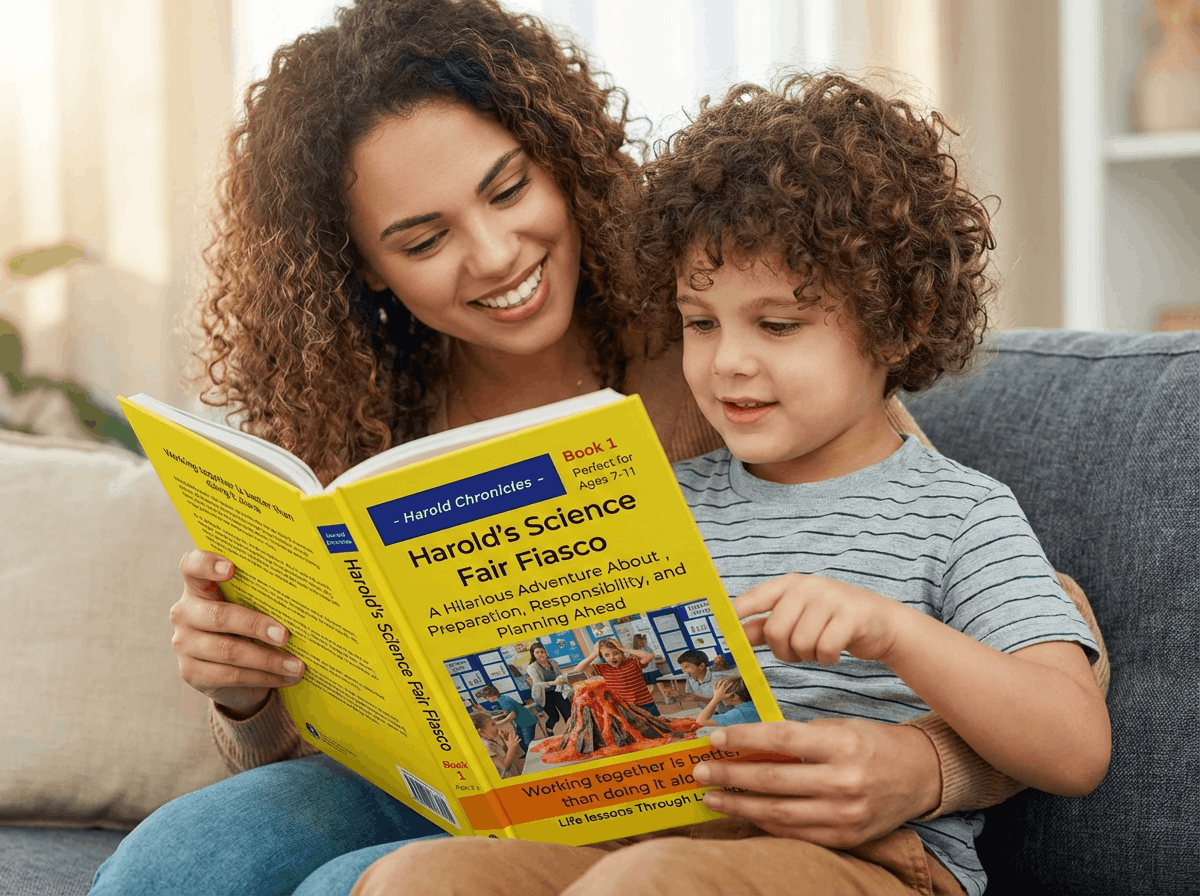
Book 1 Science Fair Fiasco
Harold waits until the last night. Chaos erupts. He learns to plan.
If you are saying
“He wants everything NOW”
He needs to learn
Patience
Get this book:
Book 3 Birthday Bash Blunder
He rushes a surprise and ruins the cake. He learns self-control.
If you are saying
“He tries to do dangerous things alone”
He needs to learn
Courage
Get this book:
Book 6 Camping Catastrophe Harold gets lost because he wouldn’t ask for help. He learns true bravery.
If you are saying
“He tells little lies to stay out of trouble”
He needs to learn
Honesty
Get this book:
Book 2 Catastrophic Pet Day
One small lie turns into a school-wide bird chase. He learns integrity.
If you are saying
“He gives up when things get hard”
He needs to learn
Perseverence
Get this book:
Book 4 Sports Day Sli Up
Harold falls flat on his fave. He finishes the race anyway. He learns grit/
Once you understand the system, you can choose the story that fits your child.
The Missing Piece:What to Say After the Story
Most parenting tools tell you what your child should learn.
But in the moment — when behaviour happens —
you’re left wondering:
What do I say?
How do I say it without it turning into a lecture?
How do I make it actually stick?
This is where most approaches fall down.
The story engages your child.
But what happens next is what shapes behaviour.
Introducing the Harold Communication Hub
The Harold Communication Hub gives you simple, practical ways to turn everyday moments into meaningful conversations.
It shows you:
how to respond without lecturing
how to guide your child to think, not just react
how to reinforce values naturally at home
how to build confidence, responsibility, and resilience over time
Powered by Two Simple Guides
Guide A (Educator Framework)— how learning is guided at school
Guide B (Parent Framework) — how you reinforce it at home
👉 Together, they create a consistent message your child understands and responds to.
This is what turns a funny story into real-life growth.
⭕ Start With One Simple Step
Join Harold’s Circle of Friends and get your Parent Starter Kit — including your first guided conversation tools.
💬 What Parents Are Saying
"I used to nag my son about packing his bag. After Book 1, I just asked: 'Are we doing a Harold this morning?' He laughed and went to check his list. It changed the whole tone of our house."— David, Father of two
"Finally, a character who isn't perfect. Harold makes the same mistakes my son makes, which makes the lessons actually stick."— Sarah J., Mum of two boys
-
You’re not alone — many children go through a phase where reading feels frustrating or overwhelming.
Hazardous Harold books are designed specifically for kids who don’t like reading. The stories are funny, fast-paced, and relatable, helping children re-engage with reading without pressure or lecturing. Many parents tell us these are the first books their child actually chooses to keep reading. -
Yes. The entire series is written with reluctant readers in mind.
The language is accessible, chapters are manageable, and the humour keeps kids turning pages. Most importantly, the stories focus on real-life situations kids recognise — which helps them feel confident rather than “behind.”em description -
Both — by design.
Each story explores everyday challenges like honesty, responsibility, patience, and learning from mistakes. The lessons are never preached. Instead, children see consequences play out naturally, which makes the learning feel real and memorable. -
Yes. Many educators and parents use the books for:
Shared reading
Small group discussion
Character education
Social emotional learning (SEL)
Because the humor draws kids in, the deeper conversations often follow naturally.
-
This is one of the core reasons Hazardous Harold exists.
Harold makes mistakes, feels embarrassed, and gets things wrong — and that’s exactly what makes him relatable. The stories help children realise they’re not “bad readers” or “bad kids,” just human ones who are still learning. -
Not at all — though many parents enjoy doing so.
The books are written so children can read independently, but they also work beautifully as shared reading. Some families read together, others talk about the story afterwards, and some simply enjoy seeing their child read willingly again. -
Most families start with Book 1 and see how their child responds.
If your child is particularly hesitant, choosing a story that mirrors a familiar situation (school mishaps, friendships, celebrations) can help them connect quickly. -
You can purchase individual books or series bundles—whatever works for your family.
-
Harold's world is age-appropriate and joyful. The later books (Arc 5: Growing Up Years) touch on topics like mental health, digital citizenship, and puberty in age-appropriate ways. We provide guidance for parents on these themes.
-
Absolutely! If they're hooked, they're ready. Many families discover Harold becomes a household favorite. Getting the series at once ensures you have the next book ready when they finish.
-
Harold isn't a behavior-modification tool, but parents consistently report that the stories give them a shared language with their children for discussing choices, consequences, and growth. When combined with the discussion guides and activities, families find meaningful conversations happening naturally.
Frequently Asked Questions often ask when reading has become a struggle