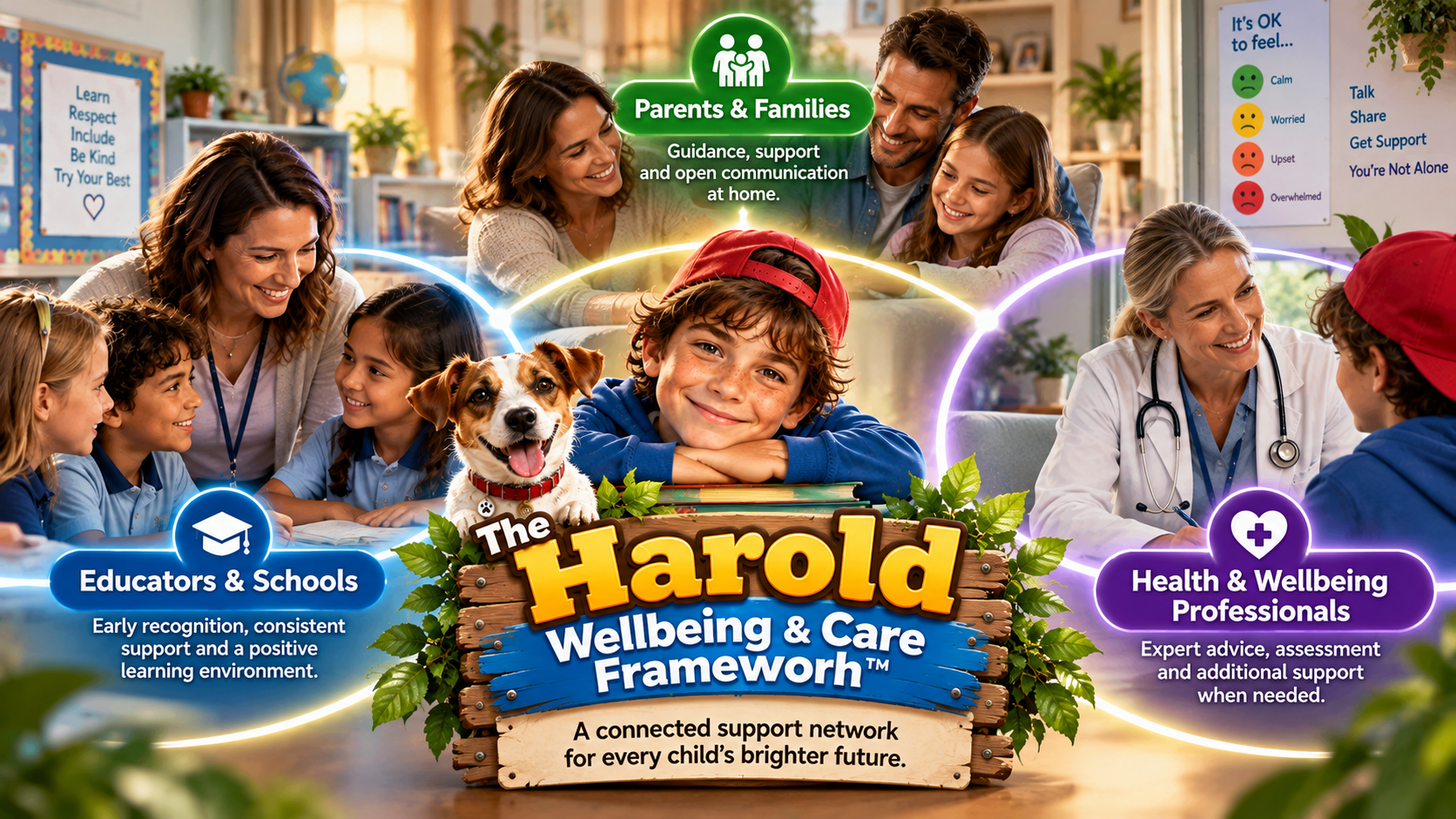
The Harold Wellbeing And Care Framework
6 Growing Up stories. Three perspectives. One connected framework for wellbeing and care.
The Harold Wellbeing & Care Framework™ supports Books 24–29 with age-appropriate resources that help young readers, parents and educators navigate the challenges of growing up—together.
Supporting Young People Through Stories, Communication, and Early Intervention
The Harold Wellbeing Framework™ is an evidence-informed approach designed to help educators, parents, and communities support the wellbeing, learning, and development of young people.
Built around the belief that the child should always remain at the centre, the framework combines literacy, wellbeing education, family–school communication, and practical support resources into one connected system.
Rather than waiting until a concern becomes a crisis, the framework encourages early awareness, meaningful conversations, and coordinated support.
One Child. One Story. One Connected Support System.
Why the Harold Wellbeing & Care Framework™ Exists
Young people today face a growing range of challenges:
School anxiety
Friendship difficulties
Digital pressures
Social isolation
Identity questions
Emotional regulation challenges
Mental health concerns
While support services exist, families and educators often struggle to know:
What should I do?
Who should I talk to?
Is this serious?
How do we communicate effectively?
When should professional support be involved?
The Harold Wellbeing & Care Framework™ was developed to help bridge these gaps through practical, easy-to-understand tools that support communication, observation, and informed decision-making.
The Three Pillars of the Framework
Pillar 1 — Wellbeing Awareness
Helping adults recognise concerns early. The framework encourages educators and families to notice changes in behaviour, emotions, learning patterns, and social engagement before problems become entrenched. Early awareness often creates the greatest opportunity for positive outcomes.
Pillar 2 — Communication
Helping the important conversations happen. Many concerns escalate because adults are unsure how to begin difficult discussions. The framework provides structured communication tools, scripts, and practical guidance that help educators speak with parents, parents speak with schools, adults speak with young people, and families navigate support pathways.
Pillar 3 — Observation & Coordination
Helping everyone work together. Effective support requires a shared understanding of what is happening and what steps should follow. The framework includes observation tools and coordination resources that help educators, parents, and support professionals work collaboratively around the needs of the child.
The Core Framework: Arc 5 Care Worksheet
The heartbeat of the system is a 34-page comprehensive resource that moves from "watchful awareness" to "crisis intervention". It includes:
Part 1: Mental Health & Wellness Resource Guide– A global directory of crisis and specialist support services across Australia, USA, UK, Canada, and New Zealand.
Part 2: Book-by-Book Observation Log– A "traffic light" communication tool for parents and teachers to record specific behavioral shifts as the child engages with the series.
Part 3: Three-Party Care Coordination Summary – A structured briefing tool to bridge the gap between home/school observations and clinical health professionals.
Part 4: Escalation & Referral Pathway– A graduated guide to help adults determine exactly when a concern warrants professional or emergency action.
Guide A: For Educators & School Wellbeing Teams
"How to initiate the conversations that matter."
Educators are often the first to notice a shift in a student’s wellbeing but may lack the specific language to raise it with families. Guide A provides:
Script Banks:Calibrated phrases for "First Contact," "Maintaining Dialogue," and "Naming Escalation".
Conflict De-escalation: Strategies for navigating difficult meetings or parental pushback.
Mandatory Reporting: Clear guidance on legal obligations and how to transparently inform families.
Guide B: For Parents & Carers
"Advocating for your child without burning bridges."
Raising a concern with a school can be daunting. Guide B empowers parents to trust their instincts and navigate the global mental health system. It includes:
The "Gut Feeling" Protocol:Knowing when to reach out even before you have "proof".
Healthcare Navigators:Step-by-step instructions for accessing Mental Health Treatment Plans and specialists in your specific country.
The Child’s Voice:How to keep your teenager informed and empowered throughout the communication process.
Observation & Coordination Tools
Effective support begins with shared understanding. These tools help educators and parents track patterns, align perspectives, and coordinate next steps. Includes:
Book-by-Book Observation Log
Traffic Light Wellbeing Indicators
Three-Party Care Coordination Summary
How the System Works
The Harold Wellbeing & Care Framework is designed to bring clarity to complex situations by aligning the key adults in a young person's life.
1. Observe — a concern is noticed at home or school, often small, sometimes uncertain, but worth attention.
2. Communicate — using the guides provided, educators and parents begin a structured, supportive conversation.
3. Track & Align — observations are recorded using shared tools, helping build a clearer picture over time.
4. Act Early — if needed, support is introduced, with clarity about when and how to involve professionals.
This approach ensures that concerns are addressed early, communication stays open, and decisions are made collaboratively — always with the child's wellbeing at the centre.
Supporting Educators
Teachers are often the first adults to notice changes in a student's wellbeing. The framework provides educators with practical tools to:
Recognise early warning signs
Document observations effectively
Communicate with families
Navigate difficult conversations
Support student wellbeing in the classroom
Understand escalation pathways
Supporting Parents & Carers
Parents know their children better than anyone. However, navigating schools, health systems, referrals, and wellbeing concerns can feel overwhelming. The framework helps families:
Understand emerging concerns
Communicate confidently with schools
Advocate effectively for their child
Access support pathways
Remain involved throughout the process
The Child-First Principle
At the heart of the Harold Wellbeing & Care Framework™ is a simple belief: the child is more important than the paperwork.
Every resource within the framework is designed to ensure that communication remains focused on the wellbeing, safety, growth, and dignity of the young person.
The goal is not simply to manage problems. The goal is to help young people thrive.
Book Title
Book 24: Harold’s Identity Investigation
Core Wellbeing Theme
Identity and self-discovery
Primary Resource (AU)
QLife
International Resource
The Trevor Project
Arc 5: Resource Mapping & Clinical Alignment
Each book in the Hazardous Harold Arc 5 series (Ages 13–15) is paired with a specific wellbeing theme and internationally recognized support organizations.
Book Title
Book 25: Harold’s AI Anxiety
Core Wellbeing Theme
AI, automation, and human value
Primary Resource (AU)
CSIRO Data61
International Resource
AI4All
Book Title
Book 26: Harold’s Friendship Friction
Core Wellbeing Theme
Changing friendships and loneliness
Primary Resource (AU)
Beyond Blue
International Resource
KidsHealth: Friendship Changes
Book Title
Book 27: Harold’s Anxiety Adventure
Core Wellbeing Theme
Mental health and help-seeking
Primary Resource (AU)
headspace / Medicare MHC
International Resource
ADAA / MindShift App
Book Title
Book 28: Harold’s Change Challenge
Core Wellbeing Theme
Puberty and body image
Primary Resource (AU)
Butterfly Helpline
International Resource
Scarleteen / NEDA
Evidence-Informed Foundations
The Harold Wellbeing Framework™ draws upon research and best practice from:
Literacy engagement
Social and emotional learning
Family–school partnerships
Youth wellbeing
Communication science
Early intervention frameworks
The Harold Wellbeing & Care Framework™ is designed as a practical communication and educational resource and is not intended to replace professional assessment, diagnosis, or clinical care.
Book Title
Book 29: Harold’s Future Focus
Core Wellbeing Theme
Goals and future anxiety
Primary Resource (AU)
My Future
International Resource
O*NET Interest Profiler
Building Stronger Connections Around Young People
The Harold Wellbeing & Care Framework™ brings together stories, educational resources, communication tools, and wellbeing supports into one connected ecosystem.
Because when families, educators, and communities work together, young people are more likely to feel supported, understood, and empowered to thrive.
-
No. It is a communication and coordination tool for parents, educators, and consulting professionals. It does not diagnose, treat, or replace clinical mental health care.
-
No. The framework complements professional services and helps families and educators navigate support pathways.
-
The framework supports educators, parents and carers, schools, wellbeing teams, and community organisations.
-
The principles of communication, wellbeing awareness, and literacy engagement underpin the entire Harold Ecosystem. Arc 5 simply explores these themes in the greatest depth, which is why the dedicated tools on this page are built around Books 24–29.
-
Use the Level 1–5 Escalation Pathway in the Arc 5 Care Worksheet. If you notice "Amber" flags (signs of struggle) in two or more areas — such as digital habits and peer relationships — it's time for a direct adult-to-adult check-in between parents and educators. If distress persists for more than two weeks, a GP appointment is recommended.
-
Effective advocacy is built on partnership, not accusation. Use Guide B: Parent Communication to find specific scripts that help you share home observations without alienating school staff. Sharing the Book-by-Book Observation Log gives the school concrete evidence of what you're seeing at home.
-
Arc 5 addresses "AI Anxiety" (Book 25) and future-focused themes (Book 29, Harold's Legacy Journey) directly. Educators can use Guide A to facilitate guided conversations that help students identify uniquely human values — like empathy and creativity — that technology cannot replace.
-
No. It is a communication and coordination aid for non-clinical use. It's designed to help the adults in a child's life communicate clearly so that clinical professionals (GPs, psychologists, and counsellors) can receive a high-quality summary of the child's needs.
Frequently Asked Questions: Youth Wellbeing & The Harold Ecosystem
Important Notice
This system is a communication aid for non-clinical use. It does not replace professional assessment, diagnosis, or clinical care. If a young person is in immediate danger, please refer to Need Help Now.