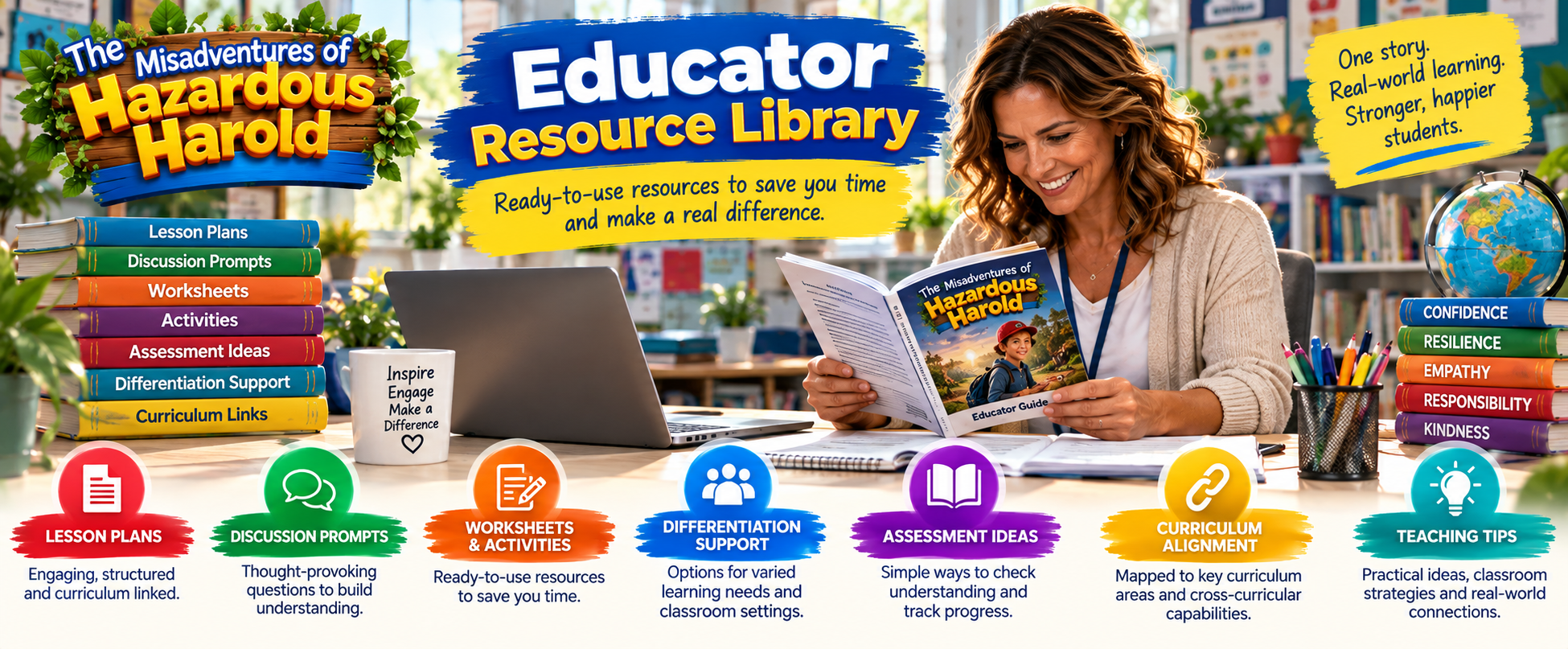
Comprehensive Educator Resource Library
Welcome to the Hazardous Harold Educator Resource Library.
This library provides teachers with ready-to-use classroom resources designed to support reluctant readers while aligning with curriculum outcomes.
Each Hazardous Harold story is supported by structured teaching materials that promote literacy, discussion, empathy, and problem-solving skills.
Classroom Starter Kit
New to Hazardous Harold?
The Classroom Starter Kit introduces the series and shows how teachers can easily integrate Harold stories into reading, literacy, and wellbeing lessons.
Curriculum Alignment
Curriculum & Learning Standards
Hazardous Harold classroom resources support literacy development, social-emotional learning, and critical thinking.
The teaching materials align with widely used United States education standards, making it easy for teachers to integrate Harold stories into reading lessons, classroom discussions, and wellbeing programs.
United States Curriculum Alignment
Hazardous Harold resources support several widely used frameworks in U.S. schools.
Common Core State Standards
Harold classroom activities support reading comprehension, writing development, vocabulary, and classroom discussion aligned with Common Core English Language Arts standards.
Reading, writing, and discussion skills supported by Harold stories
CASEL Social Emotional Learning Framework
Harold stories help students explore empathy, decision-making, and relationship skills that align with the CASEL Social Emotional Learning framework.
Empathy, self-awareness, responsible decision making.
SEL & Character Education
Hazardous Harold activities encourage reflection on empathy, responsibility, resilience, and problem-solving, supporting school programs focused on character education and social-emotional development.
International Curriculum Alignment
Hazardous Harold classroom resources are designed to support literacy development, student wellbeing, and reflective learning.
While the series aligns closely with United States learning standards, the themes explored in Harold’s stories — empathy, responsibility, decision-making, and problem-solving — also connect strongly with the educational frameworks used in many other countries.
Teachers in international classrooms can easily adapt Harold activities to support reading comprehension, discussion, and social-emotional learning outcomes.
Australia
Hazardous Harold stories support several areas of the Australian Curriculum, particularly within English and General Capabilities.
Classroom discussions and guided reflection activities help students develop:
• Reading comprehension
• Critical and creative thinking
• Personal and social capability
• Ethical understanding
• Communication and discussion skills
These capabilities encourage students to analyse behaviour, reflect on consequences, and explore respectful relationships.
Canada
Canadian schools emphasise literacy development, student wellbeing, and social responsibility across many provincial curricula.
Hazardous Harold classroom activities support these goals by encouraging students to:
• develop reading comprehension skills
• analyse character decisions and consequences
• discuss ethical choices and responsibility
• practise respectful communication and collaboration
Harold stories can be integrated into literacy lessons or wellbeing programs that encourage thoughtful classroom discussion.
New Zealand
The New Zealand Curriculum emphasises the development of Key Competencies that prepare students for lifelong learning.
Hazardous Harold activities support several of these competencies, including:
• Thinking
• Relating to others
• Managing self
• Participating and contributing
By reflecting on Harold’s experiences, students are encouraged to think critically, communicate their ideas, and develop empathy and responsible decision-making.
Hazardous Harold classroom resources are designed to be flexible, allowing teachers in different education systems to adapt lessons to their own curriculum outcomes and classroom goals.
United Kingdom
Hazardous Harold resources can support the UK National Curriculum for English and PSHE (Personal, Social, Health and Economic education).
Through storytelling and guided discussion, students can explore:
• Reading comprehension and interpretation
• Character analysis
• Speaking and listening skills
• Personal responsibility
• Social awareness and empathy
The reflective nature of Harold’s adventures makes them well suited to classroom discussions that build both literacy and personal development.
📚 Evidence & Research Behind Harold